
Affiliate Disclosure: As an Amazon Associate, I earn from qualifying purchases made through links on this page, at no extra cost to you. Prices shown were checked at the time of writing and can change — the live price is always on the product page.
A small kitchen rarely has a storage problem. It has a placement problem: the blender lives on the counter you need for chopping, the pans are stacked in the cabinet you can’t reach, and the spices are in three places at once. Good small kitchen organization isn’t about buying more containers — it’s about giving every zone of the kitchen one job, and every item one home.
Below is the exact system: 13 ideas organized by zone — counters, cabinets, drawers, sink, walls, doors, and corners — with the few products that genuinely earn their space, all renter-friendly and all under $40. No renovation, no drilling unless you want to, and most kitchens can be done in one afternoon.
✅ In the next 5 minutes, here’s exactly what you’ll get:
- 13 zone-by-zone ideas — small kitchen organization broken into counters, cabinets, drawers, sink, walls, doors and corners, fixed one area at a time
- 7 product picks compared — size, price, and who each one is really for
- The counter rule that instantly makes a tiny kitchen feel twice as big
- Everything under $40 and renter-safe — no drilling, no renovation
📑 What’s in This Guide
The Short Answer
If you do only three things, do these: (1) clear the counters down to daily-use items only, (2) put a two-tier organizer under the sink and in your deepest cabinet so the back row slides to you, and (3) move knives and utensils onto the wall. Those three moves fix about 80% of small kitchen organization frustration, for under $60 total. Everything else in this guide builds on them. This kitchen system is one room of the whole-home approach in our pillar guide on how to organize small spaces — start there if the whole apartment needs help, not just the kitchen.
Quick Picks: The 7 Products That Earn Their Space
Most kitchen organizers are clutter with better marketing. These 7 solve a specific zone problem, and each one replaces or unlocks space instead of just dividing it:
| Product | Zone | Price | Why It’s Our Pick |
|---|---|---|---|
| ⭐ BEST ALL-ROUNDER madesmart 2-Tier Organizer | Cabinets & under-sink | ~$17 | Sliding baskets bring the back of deep cabinets to you; fits around sink pipes |
| 🍴 BEST FOR DRAWERS Joseph Joseph DrawerStore Compact | Drawers | ~$20 | Layered tray holds 48+ cutlery pieces in half a normal tray’s footprint |
| 💧 BEST FOR TINY COUNTERS Seropy Roll Up Dish Drying Rack | Over the sink | ~$12 | Deletes the counter dish rack and returns ~2 sq ft of prep space; one of Amazon’s best-selling roll-up racks |
| 🔄 BEST FOR CORNERS Copco Non-Slip Turntable, 18″ | Corners & fridge | ~$18 | One spin reaches every jar — nothing expires forgotten at the back again |
| 🧱 BEST FOR TALL CABINETS Amazon Basics Stackable Cabinet Shelves (Set of 2) | Tall cabinets | ~$17 | Stacks a full second level inside tall cabinets — plates below, bowls above, no wasted air |
| 🔪 BEST FOR WALLS Modern Innovations Magnetic Knife Strip, 16″ | Walls | ~$17 | Kills the bulky knife block and frees a drawer; knives visible and grab-ready |
| 🚪 BEST RENTER PICK SimpleHouseware Over-Cabinet-Door Organizer | Cabinet doors | ~$15 | Hooks on in seconds, holds wraps, lids and cutting boards — zero tools, zero holes |
The Zone System: 3 Rules Before You Buy Anything
Rule 1: Every zone gets one job. Prep zone near the stove, washing zone at the sink, storage zone in the cabinets farthest from both. When an item’s home matches where it’s used, small kitchen organization maintains itself — you’re never carrying things across the room.
Rule 2: Daily items at arm’s reach, the rest up or down. The shelf and drawer space between knee and shoulder height is prime real estate. Weekly items go high or low; monthly items (the roasting pan, the waffle maker) leave the kitchen entirely if they must — the same principle behind our small apartment storage fixes.
Rule 3: Nothing loose in a deep space. Drawers, deep cabinets and the fridge all follow this: loose items migrate to the back and die there. Everything deep gets a tray, tier, divider or turntable. Buy for depth first, width second.
13 Small Kitchen Organization Ideas, Zone by Zone
Counters: Ideas 1–2
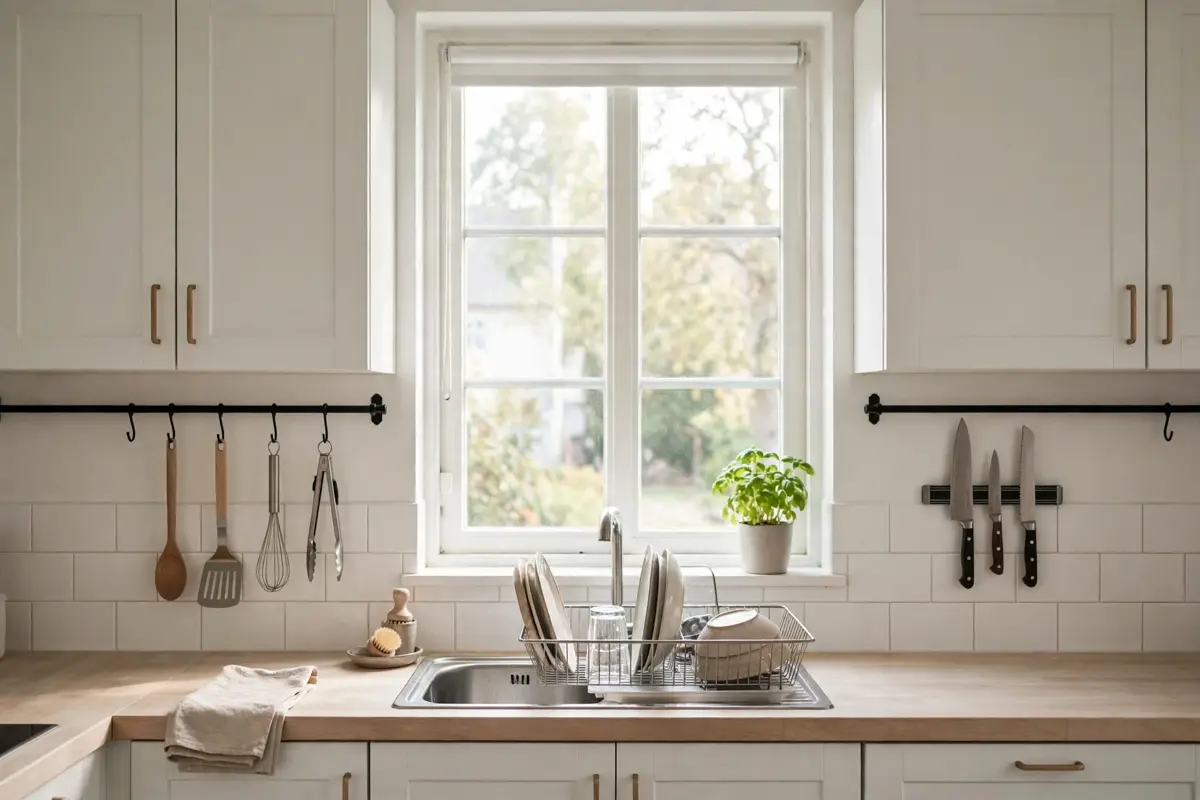
1. The daily-use test. Empty the counters completely, clean them, then put back only what you touched in the last 24 hours. In most small kitchens that’s a kettle or coffee maker and nothing else. Live with the clear counters for a week before deciding anything else “needs” to come back — this single idea is why organized small kitchens photograph so well.
2. One tray, one home for the strays. Cooking oil, salt, and the utensils you cook with daily are allowed to stay out — but corralled on one small tray or in one crock beside the stove. A group reads as intentional; the same items scattered read as mess.
Cabinets: Ideas 3–4
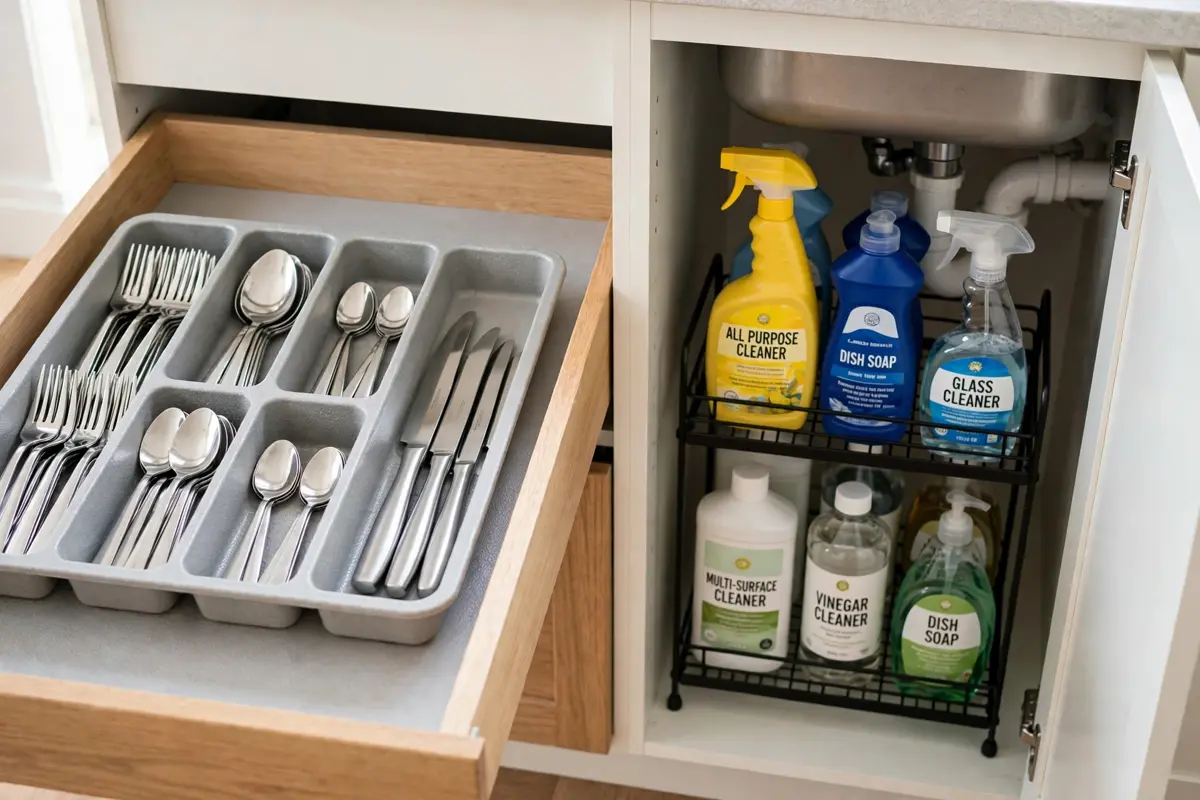
3. Two tiers under the sink and in the deepest cabinet. The under-sink cabinet is where cleaning supplies go to be forgotten, because pipes block the middle and everything stacks in front of everything else. The madesmart 2-Tier Organizer (about $17, 14.3 × 10.6 × 9 inches) slides its two baskets out like drawers, fits beside the pipes, and comes with dry-erase dividers for labeling. Reviewers at The Spruce rated it their best drawer-style under-sink pick, and it’s the highest-impact $17 in this whole guide — put the second one in your deepest food cabinet.
4. Double tall cabinets with stackable shelves. Most upper cabinets waste a foot of air above the plates. Amazon Basics Stackable Cabinet Shelves (set of 2, around $17, each 12.5 inches long) stack into a full second level for mugs, bowls or pantry jars — plates on the cabinet floor, bowls on the shelf above them, nothing nested into a teetering pile. Measure your cabinet’s inside width first, and put the heaviest stack on the bottom level.
Drawers: Ideas 5–6
5. A compact layered cutlery tray. A flat cutlery tray wastes half its drawer. The Joseph Joseph DrawerStore Compact (around $20) layers angled compartments so a full 48+ piece set fits in the footprint of a small tray — in a two-drawer kitchen, that hands you back an entire drawer. It needs at least 3.25 inches of drawer height, so measure before ordering.
6. Dividers for the junk-prone utensil drawer. Whatever drawer holds spatulas and peelers also collects batteries and rubber bands. Spring-loaded bamboo dividers (or a simple set of small boxes) split it into fixed lanes: cooking tools, baking tools, and one — only one — miscellaneous lane. When a lane overflows, something leaves the kitchen. That’s the rule that keeps it working.
Sink Zone: Ideas 7–8
7. Roll the dish rack over the sink. A counter dish rack in a small kitchen is a permanent tenant on your only prep surface. The Seropy Roll Up Dish Drying Rack (around $12, 17.5 × 11.8 inches of stainless steel wire) unrolls over the sink, holds a full load of dishes, and rolls back into a drawer when you need it gone. It is one of the best-selling roll-up racks on Amazon for a reason — and it returns roughly 2 square feet of counter, every single day. Measure your sink’s width first: the rack needs a few inches of ledge on both sides.
8. A sink-side caddy, not a sink-side scatter. Sponge, brush and soap get one small caddy with drainage, ideally inside the sink’s edge or on the faucet. Bottles of washing liquid go under the sink on the two-tier organizer from Idea 3 — the counter keeps nothing but the caddy.
Walls: Ideas 9–10
9. Knives on a magnetic strip. A knife block is a counter hog and a drawer full of loose knives is a hazard. A 16-inch magnetic knife strip — the Modern Innovations stainless bar (around $17) is the long-running bestseller — puts every blade visible, reachable and off the counter. Renters: adhesive-mount versions exist, or mount the strip on the inside of a cabinet door instead. Keep it out of small children’s reach.
10. A rail with hooks for utensils and mugs. The wall between counter and cabinets is free storage wearing a disguise. One rail with S-hooks takes the ladles, spatulas and measuring cups that jam your utensil drawer, plus the mugs that eat a shelf. For more wall-storage patterns beyond the kitchen, The Spruce’s small apartment storage ideas are worth a look.

Doors: Idea 11
11. The inside of every cabinet door is a shelf you haven’t built. The SimpleHouseware Over-Cabinet-Door Organizer (around $15) hooks over a door in seconds and holds cutting boards, wraps, lids or cleaning bottles flat against the door — using space that is currently air. No screws, no adhesive, and it leaves with you when you move. Put one on the under-sink door and one on the pantry cabinet.
Corners & Fridge: Ideas 12–13
12. A turntable in every corner. Corner cabinets and the back of the fridge share one disease: things go in and are never seen again. The Copco Non-Slip Turntable (18-inch, around $18) fixes both — one spin brings every jar to the front, and the non-slip surface keeps bottles upright while it turns. Use the 18-inch in a corner cabinet, a 12-inch in the fridge.
13. Claim the gap beside the fridge. Most small kitchens have a 6–10 inch slot between fridge and counter that’s currently storing dust and one fallen spatula. A slim rolling cart turns it into a spice and oil pantry — our guide to the best storage units for small spaces includes the rolling cart we rate highest, which holds 44 lb per shelf and rolls out only when needed.
5 Mistakes That Make a Small Kitchen Worse
1. Buying organizers before decluttering. Organizing clutter just gives clutter compartments. Always do the daily-use test (Idea 1) first, then measure, then buy.
2. Matching container sets for open shelves. Pretty decanted jars look great on Instagram and waste 20–30% of shelf space to their own packaging shapes. In closed cabinets, original packaging stacks tighter.
3. Storing daily items in the hardest places. If the mugs are above the fridge and the plates are by the sink, you’ll leave both on the counter. Placement beats willpower, every time.
4. One giant “everything” drawer. A drawer without lanes becomes a junk drawer with ambitions. One job per drawer, dividers inside it.
5. Ignoring the door and wall space. In a small kitchen, cabinets and drawers are maybe 60% of your storage. The walls, doors and over-sink space are the other 40% — and most small kitchen organization plans never touch them.
Frequently Asked Questions
How do I organize a small kitchen with no pantry?
Turn one cabinet into a pantry zone: use an expandable shelf to double the levels, a turntable for jars and cans so nothing hides at the back, and the inside of the cabinet door for spices and wraps. Group food by meal type (breakfast, cooking, snacks) instead of by package size — you will find things faster and stop buying duplicates.
What should I keep on the counter in a small kitchen?
Only what you use every single day — for most people that is a coffee maker or kettle, a knife block or strip, and maybe a fruit bowl. Everything else (toaster, blender, stand mixer) should live in a cabinet and come out when used. A clear counter is the single biggest factor in whether a small kitchen feels calm or chaotic.
Are over-sink dish racks worth it in a small kitchen?
Yes — a roll-up rack over the sink replaces a counter dish rack entirely, which returns roughly 2 square feet of prep space, the scarcest resource in a small kitchen. Roll-up racks also double as a trivet for hot pans and a rinsing surface for fruit and vegetables, and they roll away into a drawer when guests come.
How do I organize deep kitchen cabinets?
Deep cabinets go dark and forgotten at the back, so never store loose items directly on the shelf. Use a two-tier organizer or pull-out basket so the back row slides to you, keep everyday items at the front, and reserve the deepest cabinets for bulky, rarely used appliances rather than daily ingredients.
What is the best way to organize kitchen drawers in a small kitchen?
Give every drawer one job — cutlery, cooking utensils, or wraps and bags — and use a fitted organizer or dividers so items stop migrating. Compact layered cutlery trays hold a full set in half the footprint of a flat tray, which frees an entire drawer for utensils in a kitchen that only has two or three.
Small kitchen organization is a weekend project, not a renovation: clear the counters, tier the deep cabinets, fit the drawers, and claim the walls and doors. Do the zones in the order above and the kitchen will start keeping itself tidy — because everything finally has exactly one place to go back to.
Affiliate Disclosure: As an Amazon Associate, I earn from qualifying purchases made through links on this site, at no extra cost to you. This helps keep our guides free — thank you for your support.