

Organizing a small space is not about buying more storage. It’s about a system — one where every item you own has exactly one home, and that home matches how often you actually use it. Get the system right, and even a 400-square-foot apartment feels calm. Get it wrong, and no amount of bins will save you.
This is the complete room-by-room guide to how to organize small spaces: the 5 rules every organized small space follows, exactly how to organize each room, the 7 mistakes that make small spaces feel smaller, and a simple 7-day plan to do it all without burning out.
✅ In the next 10 minutes, here’s exactly what you’ll get:
- The 5 rules behind every organized small space (steal these and half the work is done)
- Room-by-room instructions — entryway, kitchen, living room, bedroom, bathroom, even studios
- A 7-day plan so you finish instead of giving up on day two
- Zero renovation, zero drilling required — everything here is renter-friendly
📑 What’s in This Guide
- The Short Answer: Organize in 5 Steps
- The 5 Rules Every Organized Small Space Follows
- Room-by-Room: How to Organize Every Small Space
- 7 Mistakes That Make Small Spaces Feel Smaller
- Your 7-Day Small-Space Organizing Plan
- Quick Wins: 5 Fixes in Under 15 Minutes
- How to KEEP It Organized
- At a Glance: Which Room Gets What Fix
- Frequently Asked Questions
The Short Answer: How to Organize Small Spaces in 5 Steps
To organize a small space: (1) declutter first — remove everything you don’t use; (2) divide the space into zones by activity; (3) store items vertically and in dead spaces like doors and under beds; (4) give every item one specific home, stored where you use it; (5) maintain it with a 5-minute daily reset. Storage products come last, not first.
That’s the whole system — the complete method for how to organize small spaces, one room at a time. Everything below is how to apply it.
The 5 Rules Every Organized Small Space Follows
Walk into any small apartment that feels spacious and calm, and you’ll find the same five rules quietly at work. Break them, and clutter wins — no matter how many organizers you buy.
Rule 1: Declutter Before You Organize Anything
Organizing clutter just gives you tidy clutter. Before you buy a single bin, go through each category of items — clothes, papers, kitchen gear, cables — and remove what you don’t use, duplicates, and “someday” items that have sat untouched for a year. In a small space this step alone typically frees up 20–30% of your storage. It’s also free. When people ask us how to organize small spaces, this is always step one — every other rule works better after it.
Rule 2: Every Item Gets a Home — and Only One
Clutter is mostly homeless items. Your keys land on the counter because they have no home; your mail piles up because it has no home. Assign each category one specific spot: keys always on the hook by the door, mail always in one tray. When something has exactly one home, putting it away takes two seconds and zero decisions — and two-second habits are the ones that survive.
Rule 3: Store by How Often You Use It
Daily items belong within arm’s reach. Weekly items can go on a higher shelf. Seasonal items — holiday gear, winter coats, spare bedding — belong in the hardest-to-reach places: the top of the closet, under the bed, the back of a cabinet. Most small kitchens feel cramped simply because the good cabinet space is wasted on a fondue set used twice a year while the everyday plates live in an awkward corner.
Rule 4: Think Vertical, Not Horizontal
Your floor is the most limited — and most visible — surface you own. Your walls, doors, and the space above furniture are almost always underused. Tall shelving, over-the-door organizers, hooks, and hanging storage move things up and off surfaces. A useful way to think about it: in a small apartment, you don’t have a space problem, you have a height problem you’re not using yet. Learning how to organize small spaces is mostly learning to see height instead of floor.
Rule 5: One In, One Out — Forever
A small space has a fixed capacity, and pretending otherwise is how clutter returns. The rule is simple: when something new comes in, something similar goes out. New shoes in, old shoes donated. This single habit is the difference between organizing once and staying organized.
Room-by-Room: How to Organize Every Small Space
Rules are the system; rooms are where you apply it. Work through one room at a time, in this order — it starts with the room that stops clutter before it spreads. The approach is the same in every room, and it is the heart of how to organize small spaces: declutter, zone, assign, contain.
The Entryway: Stop Clutter at the Door
Every apartment has an entryway, even if it’s just the wall beside the door — and it’s where clutter is born. Keys, mail, bags, and shoes land here first and migrate everywhere else. Create a simple “drop zone”: one hook or small tray for keys, one spot for mail, and a defined home for shoes (a slim rack, a basket, or a single mat). This takes ten minutes to set up and prevents half the mess in the rest of your home.
The entryway rule is containment: nothing that lives here should overflow. Shoes get one rack and one rack only — if the rack is full, a pair leaves. Mail gets one tray; when it’s full, it gets sorted, not stacked higher. A small bench or stool by the door earns its spot twice: it’s where you sit to put shoes on, and the space beneath it is one more contained home. And if you have guests, the entryway is their first impression — keeping it clear makes the whole apartment feel larger than it is. Entryways are where learning how to organize small spaces pays off fastest, because every other room benefits.
The Kitchen: Clear Counters, Doubled Cabinets
Start your kitchen organizing with the sink-to-stove triangle: the area between these two points is where you actually cook, so it must stay clear above and below. A roll-up dish rack that lives over the sink instead of on the counter gives you back a full arm’s length of prep space instantly. Then work cabinet by cabinet — pull everything out, group by category, and only put back what earns its spot under Rule 1. When you move seasonal or single-use appliances to the highest shelves, you’ll typically find the kitchen you thought was too small was just badly arranged. Whenever someone asks how to organize small spaces in the kitchen, the answer is almost always frequency first.
In a small kitchen, counter space is cooking space — protect it. The only things that earn a permanent counter spot are the ones you use every single day. Everything else goes up or in: cabinet door organizers, under-shelf baskets, and a roll-up dish rack over the sink can effectively double a small cabinet’s capacity. Store by frequency (Rule 3): everyday plates and glasses at eye level, the rarely-used appliances up high or in the back.
The Living Room: One Room, Clear Zones
Set up zones with a “boundary audit”: can you tell, standing at the door, where each activity happens? If not, the zones don’t exist yet — add the rug, the shelf divider, or the lighting change that marks them. For the work zone, everything work-related must fit in one container or drawer at day’s end; if the desk sprawls, the zone is too small and the stuff needs a different home. Lighting doubles as zoning: a brighter task lamp over the work spot and warm lamps over the relax spot teach your brain where each activity lives, which makes staying organized feel natural instead of forced.
Your living room is probably also your office, gym, and guest room. The trick is zones: a rug under the coffee table defines “relax,” a small desk or even one end of the dining table defines “work” — and each zone keeps its own items. If work papers keep colonizing the sofa, the zone has no boundary and no storage. Give each zone one contained storage piece — a storage ottoman is the classic for a reason: seating, footrest, and a hiding place for blankets and remotes in one footprint. For visual inspiration, The Spruce’s small apartment storage ideas are worth a browse before you buy anything.

The Bedroom & Closet: Where 70% of Clutter Lives
Work the closet with a simple sort: everything out, then back in by frequency — daily items at eye level, weekly items above and below, seasonal items straight to under-bed boxes. Most closets are only using about half their vertical space: the floor piled with shoes, the shelf above the rod half empty. A hanging organizer fills the middle air, a two-tier rod doubles hanging capacity for shirts, and shoes go on a slim rack on the floor or in clear boxes. Keep one empty shelf on purpose — that empty space is the buffer that keeps the closet from refilling to the brim.
If your home has one chaos zone, it’s probably here. Start with the closet: divide it vertically with a hanging organizer, move off-season clothes into low boxes under the bed, and keep only what you reach for weekly at eye level. Under the bed is the single biggest dead space in most apartments — a full season of clothing can live there invisibly. For the exact product picks and closet fixes, see our guide to the best storage solutions for small apartments.
The Bathroom: Small Room, Vertical Answers
In the bathroom, give every category a layer: daily essentials (toothbrush, cleanser) on the counter or a small tray; weekly items (masks, treatments) on a shelf; and backups and bulk stock under the sink or in a lidded bin. Because humidity wrecks cardboard and rusts metal, choose plastic, acrylic, or sealed containers here. An over-the-door organizer on the bathroom door turns five square feet of nothing into the home for cleaning supplies and backup toiletries — space your cabinets never had to hold.
Bathrooms have almost no storage by design, so everything must go vertical or on the door: an over-the-toilet shelf, a hanging door organizer for toiletries, and hooks instead of towel bars (they hold three towels in the space of one). Keep the counter to the two or three things you use twice a day; everything else gets a shelf, a hook, or a bin.
The Studio: Living in One Box
Choose furniture that changes jobs by time of day: a folding desk that closes against the wall turns “office” back into living space at dinner; a sofa bed or a bed with storage drawers turns “bedroom” into “guest room.” Keep the center of the room open — the one thing studios can’t fake is floor space, so resist the urge to fill it. And because a studio is always “on display,” use matching or closed storage (baskets with lids, fabric bins, cabinets) rather than open piles; visual calm in one room matters twice as much as in five.
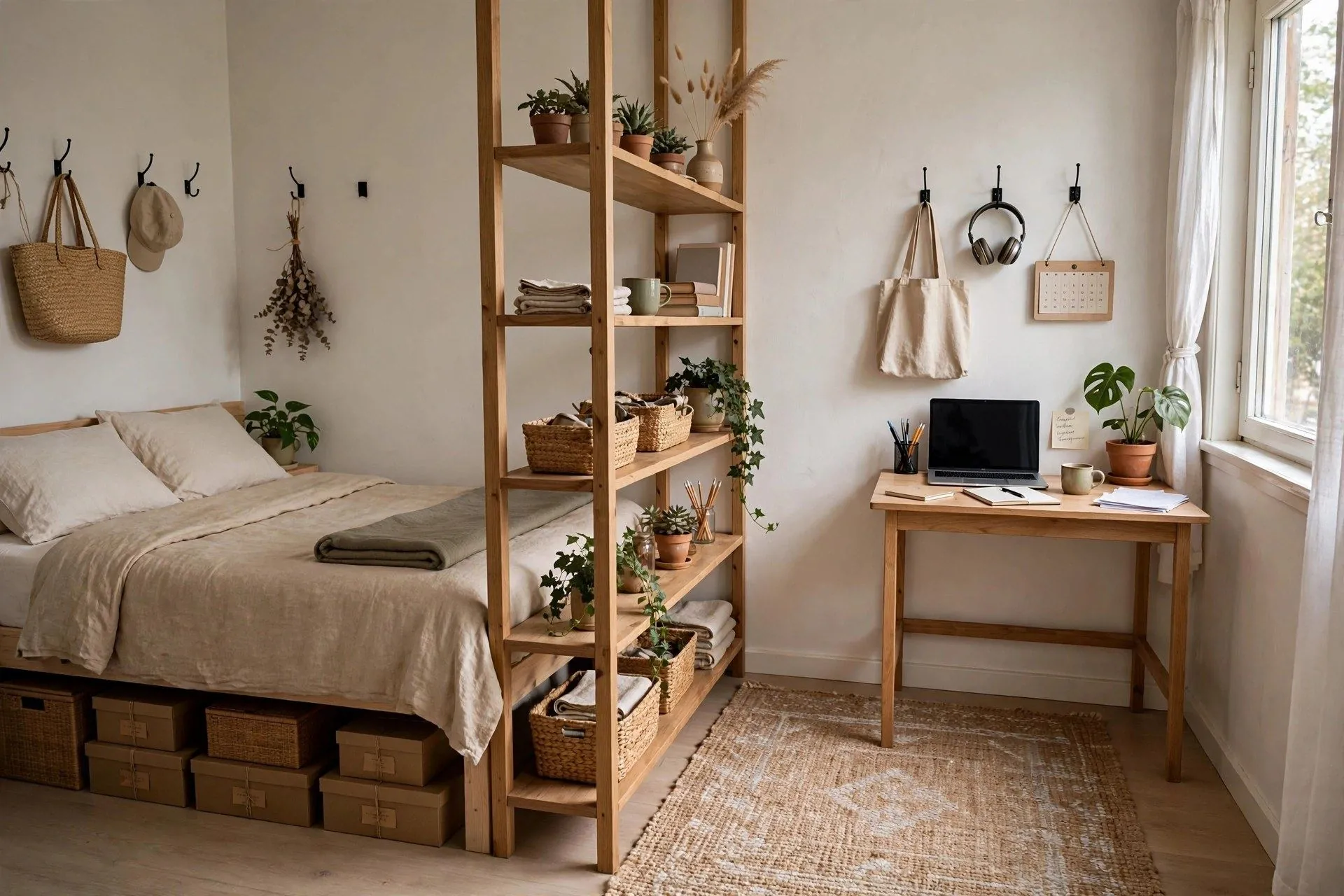
A studio is the final boss of small spaces: bedroom, office, and living room in a single room. The answer is still zones — but here they’re non-negotiable. Separate sleep from work with a rug, an open shelf unit, or a curtain. Keep each zone’s belongings strictly inside it, choose furniture that does two jobs (a bed with drawers, a desk that folds), and push storage vertical so the floor — your only real luxury — stays clear. When everything has a zone and a home, a studio stops feeling like a bedroom you live in and starts feeling like a small home. Master the studio and you have mastered how to organize small spaces anywhere.
7 Mistakes That Make Small Spaces Feel Smaller
1. Buying storage before decluttering. You’ll buy containers for things you should have thrown away — and the containers become clutter too.
2. Buying bulky storage furniture. A giant storage unit in a tiny room eats the space it was meant to save. Slim, tall, and wall-mounted almost always beats big and deep.
3. Ignoring dead space. Behind doors, under the bed, above the toilet, on top of cabinets — the average small apartment has 30+ square feet of unused storage hiding in plain sight.
4. Storing things far from where you use them. Pajamas across the room from the bed and coffee supplies away from the coffee maker guarantee those items end up “temporarily” everywhere.
5. No limit on categories. Containers are limits. If the bin is full, something leaves — that’s not harsh, that’s the system working.
6. Keeping “someday” items. The bread maker for the bakery phase that never came is costing you rent. In a small space, every item pays for its spot with usefulness.
7. Organizing once, maintaining never. A perfect system with no reset habit lasts about two weeks. Maintenance (below) is half the system.
Your 7-Day Small-Space Organizing Plan
Trying to organize a whole apartment in one day is why most people quit. One focused job per day finishes the system in a week — follow it once and you will never have to wonder how to organize small spaces again:
Day 1 — Declutter only. One bag (or three) out the door. No organizing, no buying. Just removing.
Day 2 — Entryway + drop zone. Hooks, a tray, a shoe home. Ten-minute setup, permanent payoff.
Day 3 — Kitchen. Counters cleared to daily-use only; cabinets rearranged by frequency.
Day 4 — Closet + under-bed. Vertical closet division, off-season clothes under the bed.
Day 5 — Living room zones. Define the zones, give each one contained storage.
Day 6 — Bathroom + doors. Over-door and vertical storage everywhere it fits.
Day 7 — Homes + labels. Walk every category: does it have exactly one home? Label the bins. Done.
Quick Wins: 5 Fixes You Can Do in Under 15 Minutes
Clear one flat surface. Pick the counter, the coffee table, or the nightstand. One clean visible surface makes the whole home feel calmer immediately.
Hang one hook by the door. Keys, bag, jacket — the drop zone starts with a single hook.
Swap your hangers. Slim hangers in place of bulky ones can free up a surprising amount of closet rod.
Empty one junk drawer into a tray. If it doesn’t earn a compartment, it probably doesn’t earn the drawer.
Fill one donation bag. Set a timer for 10 minutes and fill it. One bag out is visible progress anywhere.
How to KEEP It Organized
The real secret behind how to organize small spaces for good is this: staying organized is a rhythm, not an event. Daily: a 5-minute reset — everything back to its home, surfaces cleared, before bed or before work. Weekly: a quick check of the three hotspots — entryway, kitchen counter, closet floor. Seasonally: one honest declutter round, rotating seasonal items between easy-reach and deep storage. And the one-in-one-out rule runs quietly in the background, always.
Start small, finish one room completely, and let the system do the rest. And when you hit a specific problem — a stuffed closet, a kitchen with no counter, a landlord who bans drilling — our room-tested fixes are in the best storage solutions for small apartments guide.
At a Glance: Which Room Gets What Fix
| Room | Biggest Problem | First Fix |
|---|---|---|
| Entryway | Clutter migrates from here | Drop zone: hooks + tray |
| Kitchen | No counter space | Move the dish rack off the counter |
| Living Room | One room, four jobs | Zones with clear boundaries |
| Bedroom & Closet | 70% of all clutter | Vertical closet division |
| Bathroom | Almost no storage | Door + vertical organizers |
| Studio | Everything in one room | Zones + furniture that changes jobs |
Frequently Asked Questions
How do I organize a small space with no storage?
Create storage where none exists: use the backs of doors, the space under your bed, vertical wall space, and furniture that doubles as storage. Start by decluttering, then give every item one specific home. In most small apartments, doors, walls, and under-bed space can replace an entire missing closet.
Where do I start when organizing a small apartment?
Start with decluttering — never organize first. Then pick the one area that frustrates you daily (usually the entryway or closet) and finish it completely before moving on. Small finished wins build momentum; half-done rooms just create more mess.
How do I organize a small space on a budget?
Decluttering is free and creates the most space. After that, the cheapest high-impact fixes are over-the-door organizers and hooks (around $10), roll-up dish racks, and clear bins from discount stores. Spend money only on the spots you use every day.
How do I organize a studio apartment?
Divide the single room into zones — sleep, work, relax, entry — using rugs, open shelving, or curtains as soft dividers. Keep each zone’s items inside that zone, use furniture that serves two jobs, and rely on vertical storage so the floor stays clear.
How often should I declutter a small space?
Do a 5-minute reset daily, a quick weekly check of hotspots like the entryway and kitchen counter, and a full declutter every season. Small spaces fill up faster than big ones, so short regular resets matter more than rare big purges.
Affiliate Disclosure: As an Amazon Associate, I earn from qualifying purchases made through links on this site, at no extra cost to you. This guide itself recommends systems, not products — product picks live in our linked guides.