
This article contains affiliate links. If you buy through them, we may earn a small commission at no extra cost to you. As an Amazon Associate, we earn from qualifying purchases.
AI disclosure: this article was drafted with AI assistance; a human chose the products, checked the prices, ratings and dimensions against live listings on 27 October 2026, and edited the final text.
How to organize cans in a deep pantry: stop storing cans in rows. Give every can a front-row spot — on a rolling FIFO rack, a tiered riser, or a turntable — so the oldest can is the one you grab next. Measure your shelf first; the right fix depends on depth and height.
Cans are the worst thing to keep in a deep cabinet. They are identical from above, they hide behind each other, and the one at the back is always the one that expires. The result is familiar: you buy a fourth can of tomatoes because you could not see the three you already had.
This guide is about cans specifically. If your bigger problem is reaching anything at the back of a base cabinet — bottles, boxes, bags — our guide to deep pantry pull-out drawers vs bins covers that.
Measure First: The 2-Minute Test
Every fix below fails if it does not fit, so measure before you buy. You need a tape measure and two minutes.
- Depth: measure from the back wall to the front edge of the shelf.
- Usable height: measure from the shelf to the underside of the shelf above (or the cabinet top) — not to the door frame.
- Width at the opening: measure the door opening, not just the inside. A face frame often makes the opening narrower than the cabinet.
- Turntable check: for a lazy susan, both the opening and the inside must be wider than the turntable. An 18-inch turntable needs more than 18 inches in every direction it spins, or it will catch on the walls.
Write the four numbers down. You will use them in every pick below.
How to Organize Cans in a Deep Pantry: The 4-Step Method
- Empty the shelf and check dates. Pull every can out. Anything bulging, leaking or badly dented on the seam goes in the bin, not back on the shelf.
- Group by what you cook with. Tomatoes together, beans together, soups together. Groups matter more than alphabetical order — you shop and cook in groups.
- Put the most-used group where your hand lands first. The front, at eye level. Backup stock and rarely used cans go higher, lower or deeper.
- Load new cans behind old ones. This is FIFO — first in, first out. Older cans move to the front and get used first. The rack in Problem #1 does this for you automatically.
Quick Picks: All 3 Compared
| Pick | Badge | Price | Rating | Why It’s Our Pick |
|---|---|---|---|---|
| Simple Houseware 3-Tier Stackable Can Organizer Rack | Best FIFO Can Rack | $25.62 | 4.5/5 | Angled shelves roll the oldest can to the front; holds up to 36 cans. |
| Dial Industries 3 Tier Expandable Shelf Organizer, Mega | Best Tiered Riser | $26.37 | 4.5/5 | Three stepped rows so back cans sit higher and stay visible; expands 13.375″–25″ wide. |
| Copco 18 Inch Lazy Susan Turntable | Best Budget / Low-Height Pick | $17.57 | 4.7/5 | Spin the back to the front; only 1.5″ tall, so it works in short cabinets. |
Prices and ratings from Amazon on 27 October 2026. Prices change — check the current price before you buy.
Problem #1: The Can at the Back Always Expires
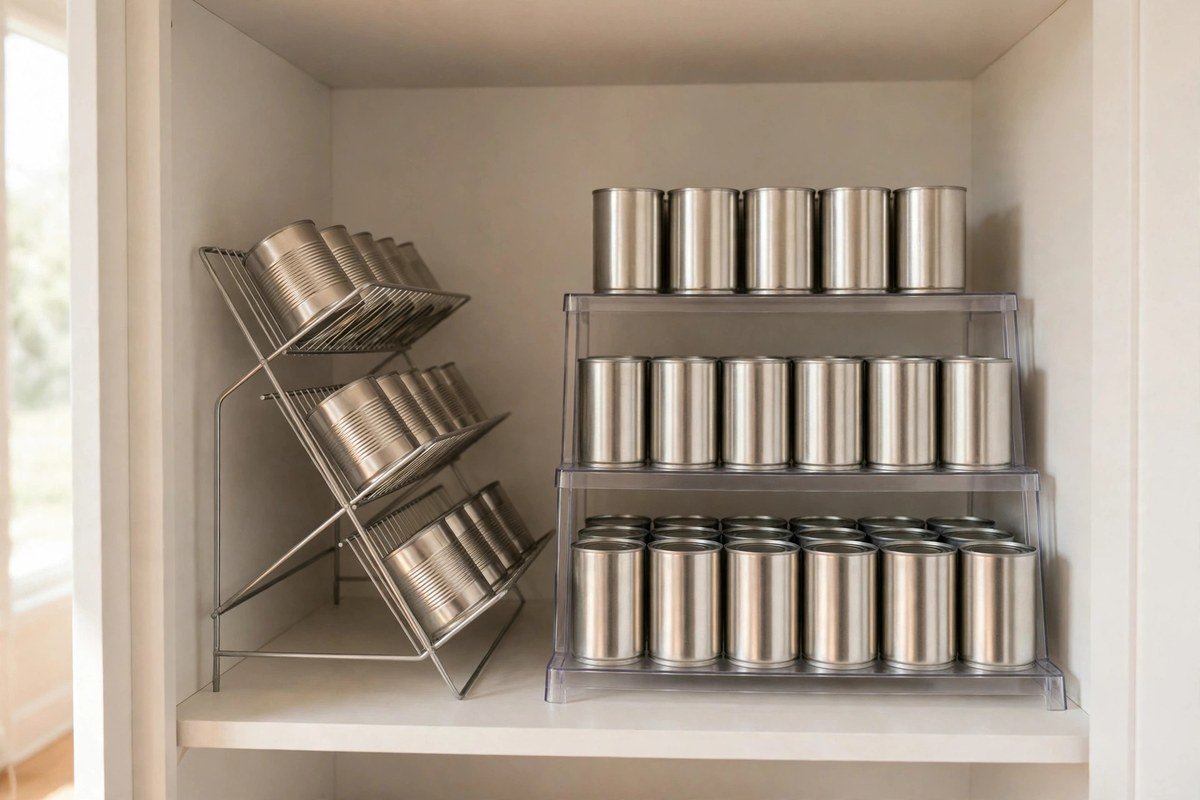
In a deep cabinet, new cans go in the front and old cans drift to the back. A gravity rack reverses that: you load from the back, and the angled shelf rolls the oldest can forward.
Our pick: Simple Houseware 3-Tier Stackable Can Organizer Rack — $25.62 (4.5/5)
- Best for: households that stock many of the same cans and keep forgetting what is already there.
- Price: $25.62 on Amazon at last check (55,430 ratings).
- Size: 11.5″D x 17″W x 13.75″H. Holds up to 36 cans, with 6 movable dividers for different can sizes.
- Why the space needed is bigger than the rack: the rack is 13.75″ tall, but the listing asks for about 16″ of height (and 12″D x 17.5″W). The extra room is for your hand: you load new cans at the top-back and lift cans off the top tier, and without clearance above it you cannot do either.
- Why it works: angled chrome shelves roll cans forward automatically, so first-in, first-out happens without you thinking about it. No tools — it assembles in about a minute and has anti-slip feet.
- Skip if: your shelf has less than about 16″ of usable height, or you store mostly tall or oddly shaped cans that do not roll.
Not the same as our drawers pick: Simple Houseware also makes the sliding basket in our drawers vs bins guide. That one is a pull-out basket for mixed items; this one is a fixed rack that rolls cans.
Problem #2: Cans Hide Behind Each Other in a Row
If you cannot fit a gravity rack, the next best thing is height. A tiered riser lifts each row a step above the one in front, so you can read the labels at the back without moving anything.
Our pick: Dial Industries 3 Tier Expandable Shelf Organizer, Mega — $26.37 (4.5/5)
- Best for: shelves of normal depth where cans line up two or three deep.
- Price: $26.37 on Amazon at last check (3,251 ratings). Made in USA, 1-year manufacturer’s defect warranty.
- Size: expands from 13.375″ to 25″ wide, 6″ tall and 11.75″ front to back. Top step is 3.5″ deep; the lower two steps are 3.875″ deep.
- Why it works: three stepped rows put every label in view, and the expanding width lets one riser fill a whole shelf.
- Know its limit: the riser is 11.75″ deep. It works best on a shelf about that deep. On a much deeper shelf, whatever you put behind it is still out of reach — pair it with the turntable below, or use the extra depth for backup stock you rarely touch.
- Skip if: you want cans to move forward on their own — a riser shows you cans, it does not rotate them.
Problem #3: A Deep Corner or a Short Cabinet
Corner cabinets and short cabinets defeat racks and risers. A turntable needs almost no height and brings the back of the shelf to the front with one turn.
Our pick: Copco 18 Inch Lazy Susan Turntable — $17.57 (4.7/5)
- Best for: corner cabinets, low cabinets and anyone on a tighter budget.
- Price: $17.57 on Amazon at last check (55,725 ratings) — below the price of the other two picks.
- Size: 18″ diameter, 1.5″ tall. The usable inside is about 1 to 1.5 inches smaller than the outside.
- Why it works: the non-skid surface and raised rim keep cans from sliding off while it spins, and it wipes clean.
- Measure first: run the turntable check from the 2-minute test. Your opening and the inside of the cabinet must both be wider than 18″, or it will not turn freely.
- Skip if: your cabinet is narrower than 18″ at any point it would spin.
How to Choose: 4 Rules Before You Buy
- Height decides first. About 16″ or more of usable height: the gravity rack. Around 6″ to 16″: the riser. Very short: the turntable.
- Depth decides second. A riser fits a shelf about 12″ deep. Deeper than that, add a turntable or keep the back for backup stock.
- Measure the opening, not just the inside. The face frame is where most returns start.
- Buy for the cans you actually keep. Rolling racks suit standard round cans. Tall, square or oddly shaped cans do better on a riser or turntable.
FAQs
What is the best way to organize cans in a deep pantry?
Give each can a front-row position. A gravity (FIFO) rack does this best if you have the height; a tiered riser works on normal-depth shelves; a turntable suits corners and short cabinets.
What does FIFO mean for canned food?
First in, first out. New cans go behind older ones, so the oldest can is always the next one you use. It keeps cans from expiring at the back of the shelf.
Should I throw out dented cans?
Throw out any can that is bulging, leaking, rusted through or deeply dented — especially on the seam or rim. A small shallow dent on the body is usually not a reason to discard, but when in doubt, throw it out.
Can I stack cans directly on top of each other?
You can, but stacked cans hide labels and the bottom can is hard to reach. A riser or a stackable rack keeps them visible and easier to rotate.
Will these organizers work in a rented kitchen?
Yes. All three are freestanding and need no screws or drilling, so they come out with you when you move.
Next, if the rest of your cabinet is still a mess, see our deep pantry pull-out drawers vs bins guide, or start with how to organize small spaces room by room.