
Affiliate Disclosure: This article contains affiliate links. If you buy through them, we may earn a small commission at no extra cost to you. This helps us keep Small Space Living free.
Here is the truth nobody tells you about small homes: the room is almost never the real problem. The wasted inches are. A 400-square-foot apartment can feel calm and open, while a place twice its size feels cramped – and the difference comes down to a handful of repeatable habits. Once you learn how to use space efficiently, you stop fighting your floor plan and start using all of it: the walls, the corners, the backs of doors, even the air above your head.
This guide breaks that skill down into 10 simple rules. None needs a renovation, most cost nothing, and each ends with a small action you can do today. For the complete room-by-room system behind them, see our pillar guide on how to organize small spaces – then use these rules to learn how to use space efficiently in daily practice.
Quick Picks: 5 Helpers That Do the Heavy Lifting
If you only buy a couple of things, make them these. Each one supports a rule in this guide, and each was chosen for the same reason: it shows how to use space efficiently by adding storage without eating floor space.
| Product | Badge | Why It’s Our Pick | Price |
|---|---|---|---|
| SONGMICS Expandable Shelf Risers, Set of 2 | Best for Vertical Space | Turns one cabinet shelf into two; expandable fit. | Around ~$24 |
| SONGMICS 43″ Folding Storage Ottoman Bench | Best Double-Duty Furniture | Seat, footrest and hidden storage in one footprint; folds flat. | Around ~$56 |
| Deco Brothers Over The Door 11 Hook Rack | Best for Dead Space | Eleven hooks on a door you already own; zero drilling. | Check Price |
| YAASHEEN Rolling Under-Bed Storage, 2-Pack | Best Hidden Storage | Wheels and handles make the under-bed zone easy to reach instead of a dust trap. | Around ~$44 |
| SPACELEAD Slim 3-Tier Rolling Cart | Best Gap Filler | Slides into the narrow gap beside a fridge or washer; 7,500+ ratings back it up. | Around ~$20 |
The 10 Rules at a Glance
- Think vertically
- Give every item a home (zones)
- Choose furniture that works twice
- Use the dead spaces
- Declutter by category, not by room
- Keep flat surfaces 80% clear
- Light, color and sightlines
- One in, one out
- Measure before you buy
- Review every season
Contents
- Rule 1: Think Vertically
- Rule 2: Give Every Item a Home (Zones)
- Rule 3: Choose Furniture That Works Twice
- Rule 4: Use the Dead Spaces
- Rule 5: Declutter by Category, Not by Room
- Rule 6: Keep Flat Surfaces 80% Clear
- Rule 7: Light, Color and Sightlines
- Rule 8: One In, One Out
- Rule 9: Measure Before You Buy
- Rule 10: Review Every Season
- Frequently Asked Questions
Rule 1: Think Vertically
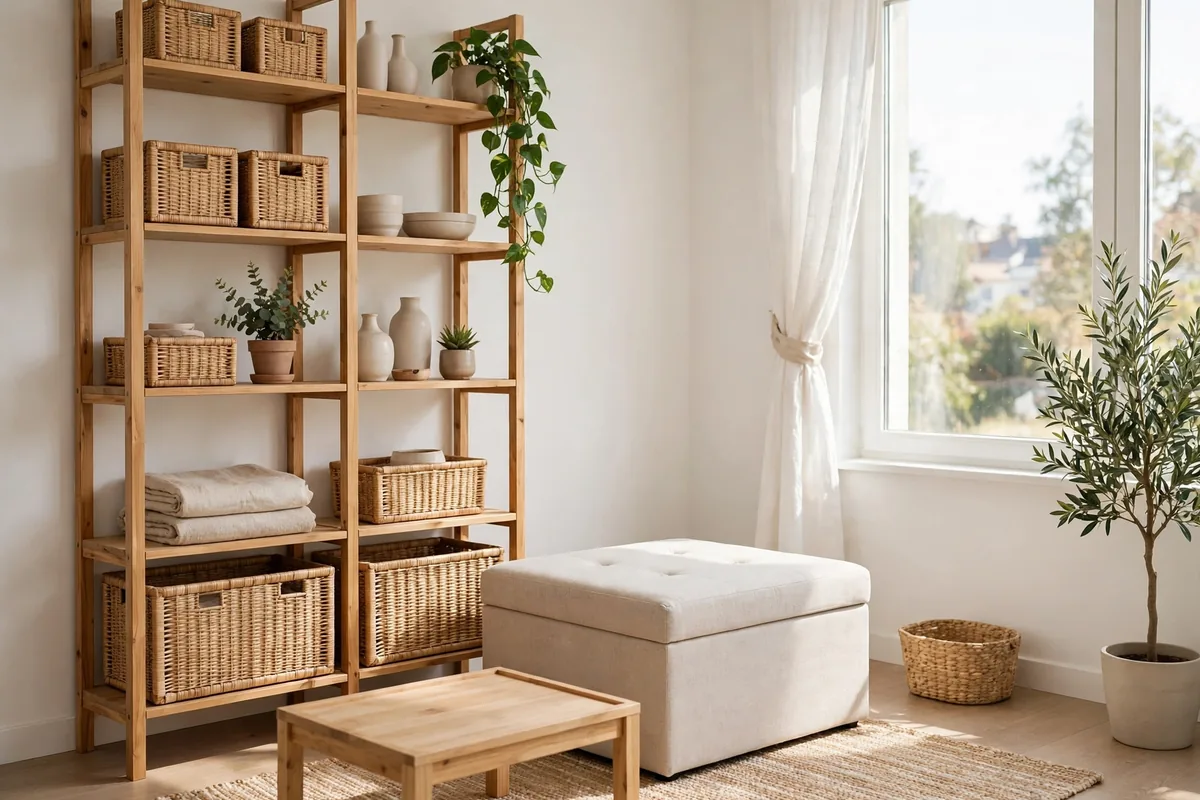
Small rooms run out of floor long before they run out of volume. Look at any cramped kitchen or bedroom: everything crowds onto the floor and counters, while the top half of every wall sits empty. Thinking vertically is the fastest way to change that ratio.
Start inside your cabinets, where the waste is easiest to fix. Cupboard shelves are spaced for tall items, so half the height above your mugs and cans is pure air. An expandable shelf riser splits that air into a second level: the SONGMICS set of two stretches to fit your cupboard width, turning one crowded shelf into two tidy rows you can actually see.
Then take the same idea to the walls: hooks and narrow shelves above door height, a tall bookcase instead of a wide low one, boxes stacked on top of the wardrobe instead of beside it. Every item that moves up frees floor – and floor is what your eyes measure when they decide a room feels “small.”
Do this today: Open one cabinet and measure the empty height above the items in it. If you can fit a fist between the contents and the shelf above, that cabinet is a candidate for a riser.
Rule 2: Give Every Item a Home (Zones)
Clutter is rarely “too much stuff.” It is stuff with nowhere assigned to live. Keys land on the counter because there is no key spot; mail spreads over the table because the table became the mail zone by accident, not by decision.
The fix is zoning – the quiet engine behind how to use space efficiently day to day. Walk through each room and name the activity in each corner: a landing zone by the door for keys, bags and mail; a charging zone with one cable spot; a getting-ready zone in the bedroom. Then give every category one specific home inside its zone – a hook, a tray, a basket, a drawer section. It does not need to be fancy. It needs to be specific.
When everything has a home, tidying becomes a 3-minute reset, because you are never deciding where things go – you already decided. Zones also expose problem areas honestly: if the landing zone overflows daily, it is too small or too far from the door, and that is useful information, not a personal failure.
Do this today: Pick the surface that collects the most random items and create one landing zone next to it – a single tray or basket. For the next week, everything that lands there goes in the tray.
Rule 3: Choose Furniture That Works Twice
In a large home, a piece of furniture can afford to do one job. In a small one, it cannot. Every item standing on your floor should earn its place at least twice – as seating and storage, as a table and a desk, as a bed and a dresser.
The classic example is the storage ottoman. The SONGMICS 43-inch folding ottoman bench works as a footrest, extra seating for guests, and a hidden chest for blankets, games or out-of-season clothes – three jobs on one small footprint, and it folds flat when you move. A coffee table with a lower shelf, a bed frame with drawers, or a drop-leaf table you shrink after dinner all follow the same principle.
When you shop, ask one question first: “What is its second job?” If a piece has no answer, it is probably wrong for a small room, however good it looks in the store.
Do this today: List the five biggest furniture pieces in your smallest room. Mark each one’s second job. The one with no second job is your first upgrade candidate.
Rule 4: Use the Dead Spaces
Every small home hides storage it is not using: the back of every door, the space under the bed, the awkward gap beside the fridge. Individually these spots look useless; together, they can equal an extra closet.
Doors are the easiest win. The Deco Brothers over-the-door rack gives you 11 sturdy hooks for coats, towels, bags or cleaning tools, hangs in a minute and needs no screws – one of the best renter-friendly upgrades there is. Under the bed is the second win: usually the largest unused volume in the home. The YAASHEEN rolling under-bed boxes (a 2-pack) add wheels and handles to that space, so it works for things you reach weekly – spare bedding, shoes, gym gear – instead of becoming a forgotten dust zone.
If your dead spaces eventually overflow too, that is the point where off-site options enter the picture – our guide to storage units for small spaces covers when renting a small unit actually makes financial sense, and when it does not.
Do this today: Stand in one room and count its dead spaces – door backs, under-furniture gaps, bare corners. Most people find four or more in the first room they check.

Rule 5: Declutter by Category, Not by Room
Most people declutter room by room, and most people stall. Categories scatter: your clothes live in the bedroom, the hallway closet and two storage boxes, so “doing the bedroom” never shows you how much clothing you actually own. You keep duplicates because you never see the full count.
Category decluttering fixes that. Pick one category – all clothing, all books, all kitchen gadgets, all cables – and gather every item of it from the whole home into one pile. The pile is always a little shocking, and that shock is the point: it makes decisions honest. Keep what earns its space, let the rest go, then assign what remains a home under Rule 2. To learn how to use space efficiently over the long term, this order matters – declutter first, organize second, buy storage last.
Do this today: Choose the smallest category you own – mugs, cables or tote bags are good starters – gather all of them in one place, and cut the pile by a third.
Rule 6: Keep Flat Surfaces 80% Clear
Flat surfaces are magnets. A clear counter invites one envelope; the envelope invites a set of keys; by Friday the counter has disappeared. Manage this “clutter creep” with one visual rule: every flat surface – counters, tables, dresser tops – stays at least 80% clear, permanently.
The 20% that remains should be deliberate: items that live there by decision (the coffee maker, a lamp, one plant), not by accident. Once a surface passes 80% full, your brain stops reading it as “surface” and starts reading it as “storage” – and the room feels smaller though nothing structural changed. It is also why hotel rooms feel spacious: their surfaces are nearly empty. If you want one habit that teaches how to use space efficiently without buying anything, this is it.
A practical trick is the nightly 3-minute reset: before bed, return everything on your surfaces to its zone from Rule 2. Because every item already has a home, tomorrow starts clear instead of inherited.
Do this today: Clear one surface completely – fully empty – then put back only what truly belongs there. Notice how the whole room feels bigger.
Rule 7: Light, Color and Sightlines
Some rooms feel small even when perfectly organized, because “feeling big” is partly visual. Three levers control it: light, color and sightlines – the unbroken views your eye can travel from the doorway.
For light, keep windows clear of tall furniture and use sheer curtains where privacy allows; a room lit to its corners reads larger than one with dark edges. For color, a light, consistent palette on the biggest surfaces (walls, bedding, rugs) removes visual “cuts” that chop a room into pieces. For sightlines, keep the path from door to far wall or window open: low furniture on that axis, tall pieces at the sides. Collections like The Spruce’s small apartment storage ideas show the same principle in real apartments – the rooms that feel biggest are the ones where your eye can travel furthest.
Do this today: Stand in the doorway of your smallest room and take a photo. Whatever blocks your eye first – a tall shelf, a dark pile, a heavy curtain – is your first fix.

Rule 8: One In, One Out
Rules 1 to 7 get a small home working; this one keeps it working. In a small space, storage is a fixed budget and every new item spends from it. One in, one out enforces the budget: when something new comes in – a shirt, a gadget, a kitchen tool – something similar goes out the same day.
It works because it moves the decision to the moment of buying, when it is easiest. Standing in the shop, “this replaces my worn-out pan” is a clear, painless trade; three months later, facing an overstuffed drawer, the same decision feels like a loss. This simple budget is also the heart of how to use space efficiently over years, not just weekends: if a new item must displace an old favorite, you only buy things genuinely better than what you own.
Keep a small donation bag or box by the door so the “out” half is effortless. When it fills, it leaves – no second review, no just-in-case shelf.
Do this today: Put an empty bag or box near your front door and label it “OUT.” The next thing that enters your home sends something into that bag.
Rule 9: Measure Before You Buy
The most expensive small-space mistakes are measurement mistakes: the shelf two centimeters too wide, the bin that fits the closet but not its door swing, the “slim” cart not slim enough for its gap. In a big home these become garage clutter; in a small one, daily obstacles.
Keep a note on your phone with your key measurements: cabinet widths and heights, under-bed clearance, closet depth, your narrowest gaps. Measure each space at its widest and tightest points – walls and frames are rarely square. The SPACELEAD slim rolling cart shows why this matters: at around $20 with 7,500+ ratings, it is a bargain only if the gap beside your fridge or washer is truly wide enough for its three tiers. Thirty seconds with a tape measure is the difference between a perfect fit and a return label.
Do this today: Measure your under-bed clearance and your two narrowest gaps, and save all three numbers in your phone under “Room Measurements.”
Rule 10: Review Every Season
Homes drift. A system that fit your life in January may not fit it in July – hobbies change, clothes rotate, work moves home or back to an office. A short seasonal review catches the drift while it is still small.
Keep it light: 30 minutes, one room, three questions. What has not been used this season? What area annoys me daily? What changed in my life that my storage has not caught up with? Then apply the earlier rules in miniature – declutter the dead category, re-zone the annoying corner, move one thing up or out. Seasonal items rotate through your hidden storage anyway, so the under-bed boxes and high shelves get a natural audit twice a year.
That is genuinely all it takes. People ask how to use space efficiently as if it were a one-time project; in practice it is a light maintenance habit built on these 10 rules.
Do this today: Set a repeating reminder for the first weekend of each new season, titled “Space Review – 30 minutes.” Future you will be grateful.
Frequently Asked Questions
When learning how to use space efficiently, what should I do first?
Think vertically. Most small rooms waste the wall space above head height. Adding shelf risers, tall shelves and hooks roughly doubles your storage without using a single extra inch of floor.
How can I use space efficiently in a rented apartment without drilling holes?
Use no-drill solutions: over-door hook racks, expandable shelf risers that sit inside cabinets, slim rolling carts for narrow gaps and under-bed storage boxes. All of these add storage and come out cleanly when you move.
Should I declutter first or buy organizers first?
Always declutter first, by category rather than by room. Organizing clutter just stores it more neatly. Once you know exactly what is staying, you can buy the right organizers in the right sizes – and you will need fewer of them.
What type of furniture works best in very small rooms?
Furniture that works twice: a storage ottoman that is also a seat and a footrest, a bed with drawers underneath, or a drop-leaf table that folds away. In a small room, every piece should earn its floor space in at least two ways.
How do I stop a small room from getting cluttered again?
Two habits do most of the work: the one in, one out rule (nothing new stays unless something similar leaves) and a short review every season. Together they stop clutter creep before it becomes another big clean-out.
How much does it cost to start using space more efficiently?
Most of the rules in this guide are free – they are about placement and habits, not purchases. If you do buy helpers, the ones we recommend run from around $20 to $56, and one or two pieces per room is usually enough.
Affiliate Disclosure: This article contains affiliate links. If you buy through them, we may earn a small commission at no extra cost to you. Prices and availability change; check Amazon for the latest details.